Navigating Ransomware Trends in Early 2026: A Practical Guide
Introduction
Ransomware remains one of the most pressing cybersecurity threats, but the landscape is constantly shifting. In the first quarter of 2026, several key trends emerged: consolidation among major groups, stabilization of attack volumes at historically high levels, and the rise of new players. This guide will help you understand these developments step by step, whether you are a security analyst, IT manager, or business leader. By following this structured approach, you can better assess your organization's risk and adapt your defenses.
What You Need
- Access to quarterly ransomware reports from reputable sources (e.g., threat intelligence firms, data leak site aggregators)
- Basic familiarity with ransomware group names and their tactics
- Comparison data from previous quarters (Q4 2025, Q1 2025, Q3 2025, etc.)
- A spreadsheet or notebook to track victim counts and group changes
- Understanding of year-over-year (YoY) and quarter-over-quarter (QoQ) metrics
Step-by-Step Guide
Step 1: Recognize the Consolidation Trend
The most notable structural shift in Q1 2026 is the move away from fragmentation toward consolidation. In previous quarters, the number of active ransomware groups had grown steadily, peaking at 85 in Q3 2025. That fragmentation diluted the market share of the top groups. However, by Q1 2026, the top 10 groups now account for 71.1% of all victims posted on data leak sites (DLS). This is a sharp reversal from the 57% share in Q3 2025. To understand this:
- Compare the Top-10 concentration in Q1 2026 (71.1%) with Q1 2024 (68%) and Q3 2025 (57%).
- Note that the total number of active groups shrank from 85 to 71. Fourteen groups that were active in Q4 2025 disappeared, while 21 new ones emerged. The net effect is consolidation around fewer dominant operators.
Step 2: Analyze Volume Stabilization
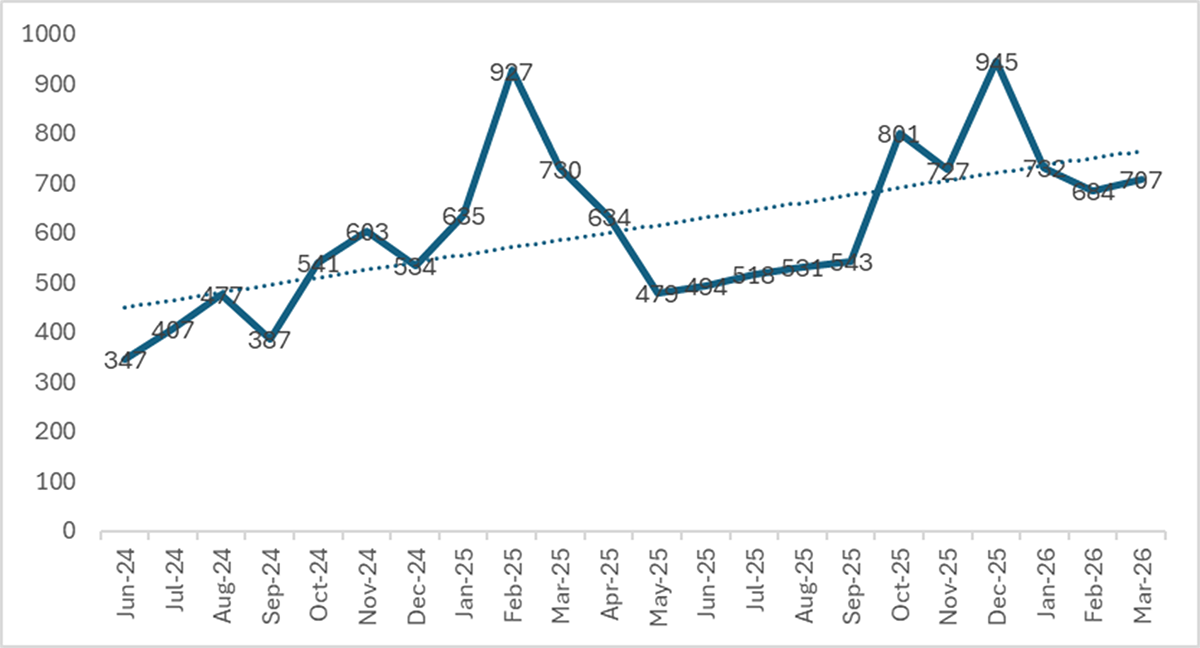
Attack volumes remain at historically high levels, though they have stabilized. In Q1 2026, 2,122 victims were posted on DLS. This is the second-highest Q1 on record, only 12.2% below the all-time Q4 2025 record of 2,416. Monthly counts were nearly flat: 732 in January, 684 in February, and 706 in March — an average of 707 per month.
- To assess stabilization, plot monthly victim counts from June 2024 through March 2026. Look for a plateau after the spikes seen in mid-2025.
- Compare Q1 2026 monthly averages with those from Q1 2025 and Q4 2025. The consistency suggests attackers have reached a sustainable operational capacity.
Step 3: Account for the Cl0p Distortion in Year-over-Year Comparisons
A simple YoY comparison shows a 7.1% decline from Q1 2025 (2,285 victims) to Q1 2026 (2,122). However, this is misleading because Q1 2025 was heavily inflated by Cl0p’s Cleo mass-exploitation campaign, which contributed ~390 victims in a single burst. To get an accurate picture:
- Exclude Cl0p victims from both years. Doing so reveals 1,894 victims in Q1 2025 vs. 1,995 in Q1 2026 — an actual YoY increase of 5.3%.
- Always filter out one-off mass exploitation events when evaluating underlying trends. Use a "core" metric that excludes large but irregular campaigns.
Step 4: Identify Key Players and Their Movements
The top of the leaderboard saw significant changes in Q1 2026. Focus on these four groups:
- Qilin – Maintained dominance for the third consecutive quarter with 338 victims. This group’s consistent output makes it a benchmark.
- The Gentlemen – The breakout story of the quarter, jumping from 40 victims in Q4 2025 to 166 in Q1 2026, reaching 3rd place globally.
- LockBit 5.0 – Confirmed its comeback with 163 victims, landing at 4th place. This indicates resilience despite law enforcement actions in prior years.
- Cl0p – While not in the top 10 for Q1 2026, its previous mass exploit still affects YoY comparisons. Monitor its activity separately.
Step 5: Track Fragmentation to Consolidation Dynamics
The ecosystem has reversed a two-year fragmentation trend. From Q1 2024 to Q3 2025, active groups increased from 51 to 85, and Top-10 share dropped from 68% to 57%. In Q1 2026, the direction flipped. To track this:
- Count the number of active groups each quarter. A decrease indicates consolidation.
- Calculate the victim share of the top 10 groups. An increase from 57% to 71% signals that power is concentrating.
- Note the disappearance of 14 groups and the emergence of 21 new ones. The net loss of 14 groups matters more than the new entries, as it reduces competition.
Step 6: Interpret Monthly and Quarterly Trends Together
For a comprehensive view, combine monthly stability with quarterly consolidation. Although volumes are flat, the structure is changing. This has implications for defenses:
- Consolidation means that a handful of groups are responsible for the majority of attacks. Focus threat intelligence on Qilin, The Gentlemen, and LockBit.
- Stable volumes imply that ransom demands and negotiation patterns may become more predictable, but competition among groups may still drive innovation in attack methods.
- New groups appearing (21 in Q1) could bring novel techniques, even if they don’t yet have large victim counts.
Tips for Applying This Information
- Don’t overreact to headline numbers – Always adjust for outliers like Cl0p to see the true trend line.
- Monitor monthly counts – The stable 700-victim-per-month pace in Q1 2026 is a new baseline. Any sudden deviation (up or down) could signal a shift.
- Watch The Gentlemen closely – A quadrupling of victims in one quarter suggests rapid growth. This group may adopt aggressive tactics or target new sectors.
- Use consolidation to prioritize – If your industry is commonly targeted by Qilin, LockBit, or The Gentlemen, prioritize defenses against their known TTPs (tactics, techniques, procedures).
- Prepare for new entrants – While 21 new groups are a small share now, they could grow. Subscribe to threat feeds that flag emerging groups.
- Integrate these insights into risk assessments – Update your organizational risk scoring to reflect the higher concentration of active threat actors and the steady attack volume.
By following these steps and tips, you can cut through the noise and understand the real state of ransomware in early 2026. The landscape is consolidating, but vigilance is as important as ever.
Related Articles
- How Microsoft Discovery Is Reshaping Research and Development with Autonomous AI Agents
- Semantic Search vs Traditional Search: Qdrant Expert Breaks Down the Key Differences and Future Applications
- Decoding the Nanoscale Order: A Guide to Relaxor Ferroelectric Breakthroughs
- Top Tech Deals: Samsung, Google, and More – Q&A Guide
- Beyond Disk Bottlenecks: How Diskless Databases Enable Real-Time Data Processing
- Deep Sea Sanctuaries: A Step-by-Step Guide to Squid Survival Through Extinction Events
- How AI and the Rubin Observatory Are Decoding Dark Energy Through Supernova 'Standard Candles'
- 5 Surprising Connections Between Venus and Hawaii's 2022 Eruption