Meta Enhances Security of End-to-End Encrypted Backups with Key Vault and Transparency Measures
The Foundation: Hardware Security Modules for Backup Key Vault
Meta's approach to protecting end-to-end encrypted backups for WhatsApp and Messenger relies on a specialized infrastructure known as the Backup Key Vault. This system leverages tamper-resistant hardware security modules (HSMs) to store recovery codes that users set to safeguard their message history. The design ensures that the recovery code remains inaccessible to Meta, third-party cloud storage providers, or any unauthorized entity. To guarantee high availability and resilience, the vault operates as a geographically distributed fleet spanning multiple data centers. It utilizes a majority-consensus replication mechanism, meaning that the system remains functional and secure even if some nodes fail.
Simplifying Backup Encryption and Introducing New Protections
In late 2023, Meta made it easier for users to protect their backups by supporting passkeys—a passwordless authentication method. Now, the company is further strengthening the underlying infrastructure for password-based end-to-end encrypted backups with two key updates: over-the-air fleet key distribution for Messenger and a commitment to publishing evidence of secure fleet deployments. These improvements build on the existing foundation to provide even greater security and transparency.
Over-the-Air Fleet Key Distribution for Messenger
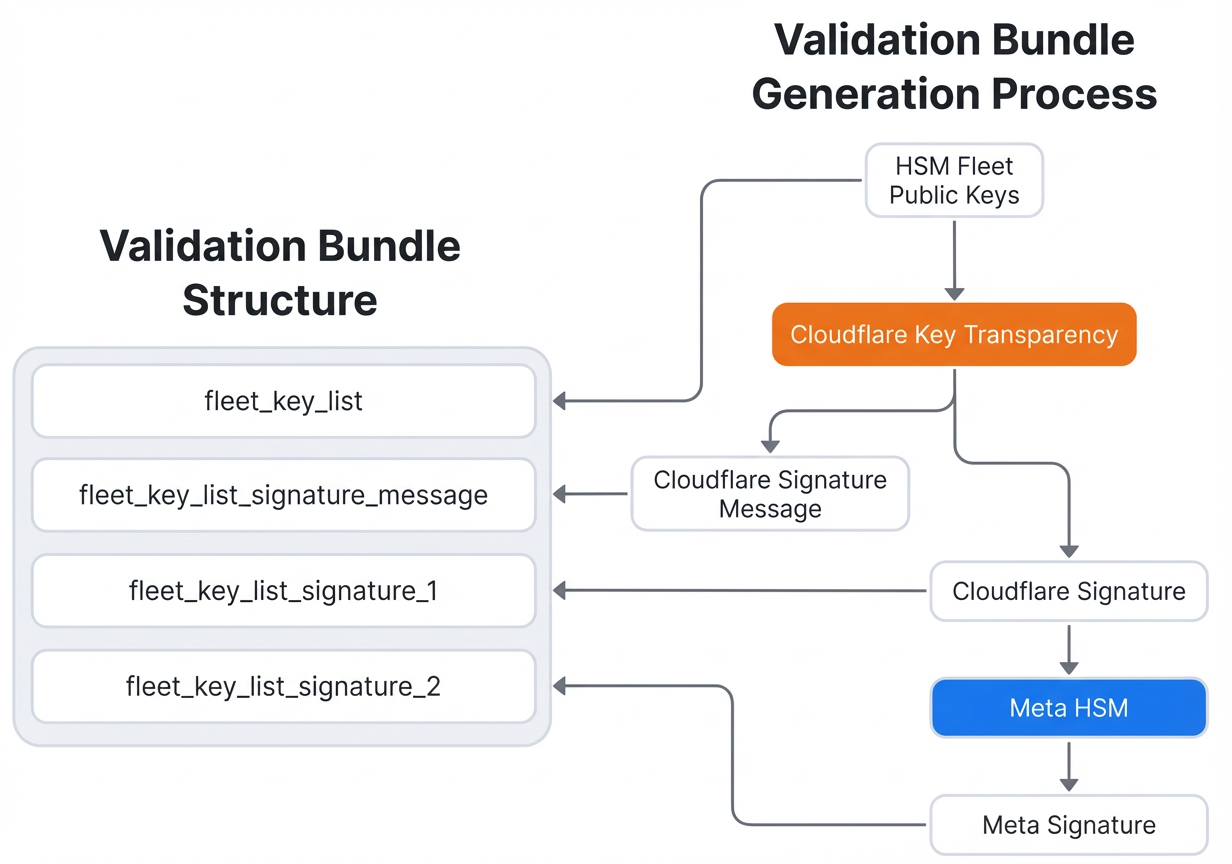
To verify the authenticity of the HSM fleet, client applications must validate the fleet's public keys before establishing a session. In WhatsApp, these keys are hardcoded into the application binary. However, to support Messenger—which requires the ability to deploy new HSM fleets without forcing users to update the app—Meta developed a mechanism to distribute fleet public keys over the air. This is achieved through a validation bundle included in the HSM response. The bundle is signed by Cloudflare and counter-signed by Meta, providing independent cryptographic proof that the keys are genuine. Cloudflare also maintains an audit log of every validation bundle, offering an additional layer of accountability. The complete protocol is detailed in the technical whitepaper, Security of End-To-End Encrypted Backups.
Greater Transparency in Fleet Deployment
Transparency is crucial to demonstrating that the system operates as intended and that Meta cannot access users' encrypted backups. To this end, Meta will now publish evidence of the secure deployment of each new HSM fleet on its engineering blog. New fleet deployments are infrequent—typically no more than once every few years—but each one will be accompanied by verifiable proof. Users can independently verify that the deployment is secure by following the audit steps outlined in the whitepaper. This commitment reinforces Meta's leadership in the field of secure encrypted backups.
Detailed Technical Specifications
For those seeking an in-depth understanding of the HSM-based Backup Key Vault, including all cryptographic protocols and implementation details, the full whitepaper Security of End-To-End Encrypted Backups is available. It covers the authentication flows, key management, and the complete validation process.
Related Articles
- Active Windows Shell Spoofing Bug Sparks Urgent Patching Debate
- Critical Linux Kernel Flaw Enables Page Cache Corruption via AEAD Sockets
- CPU-Z Download Portal Compromised: AI-Driven EDR Foils Stealthy Watering Hole Attack in 19-Hour Breach
- How to Survive a Canvas Outage During Final Exams: A Step-by-Step Guide
- Responding to a Cyberattack on Learning Platforms: A Case Study of the Canvas Incident
- Revolutionary 3D-Printed Y-Zipper Lets Flat Materials Morph into Rigid Structures in Seconds
- Amazon SES Exploited in Massive Phishing Campaign; Experts Warn of Credential Theft
- Zero Trust Access for Windows: HashiCorp Boundary and Vault Eliminate Static Credential Risks